Christmas Nutcracker Machine Embroidery
A Whimsical Sketch That Catches Eyes—Not Just at the Craft Fair, But on Every Product
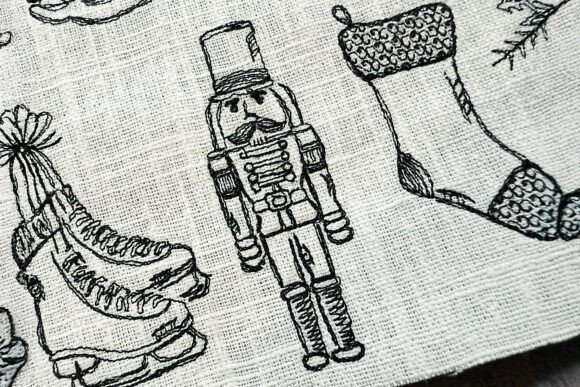
As an embroidery designer who’s prepped over 200 craft fair booths—and shipped thousands of handmade products to Etsy sellers and boutique makers—I opened the Christmas Nutcracker Machine Embroidery file with one question: Does this stop people mid-aisle? The answer? Yes—but only when paired with the right product and execution. This isn’t a bold, graphic nutcracker. It’s a whimsical sketch: delicate, hand-drawn, full of personality and subtle holiday charm. Think farmhouse meets vintage storybook—not glittery mall decor. That mood is its superpower. It reads as intentional, not generic. And in a sea of mass-produced holiday prints, that’s pure gold for small shop owners and handmade market sellers.
Where It Shines: Real Craft Fair Products That Sell
This Christmas Nutcracker Machine Embroidery design thrives where craftsmanship is visible and tactile. On a heavyweight linen tea towel? Perfect—the sketch lines echo the natural slubs and softness. On a cotton canvas tote bag? Ideal when placed off-center near the bottom hem—small enough to feel curated, large enough to read from three feet away. As apron embroidery? A quiet standout on the chest pocket or bib corner—elegant without shouting. For embroidered patches? It’s a winner: clean outline style holds up beautifully after cutting and heat-sealing, and customers love attaching them to denim jackets or market bags.
It also performs strongly on pillow covers and fabric pouches—especially in neutral palettes (cream, oat, charcoal). Why? Because the sketch aesthetic feels designed, not stamped. Buyers associate that look with care, attention to detail, and premium handmade quality. Even as a small-scale motif on a set of holiday napkins or a gift tag, it adds cohesion across your booth display—tying together otherwise disparate items under one cohesive, charming theme.
What Holds It Back (And How to Work Around It)
This isn’t a “drop-in-and-stitch” design for beginners—or for every fabric. The intricate Outline Sketch Style means fine lines, subtle spacing, and intentional negative space. That’s beautiful… until you try it on a thick terry cloth towel or a curved cap surface. On textured fabrics, some delicate strokes can blur or disappear. On dark fabric, low-contrast thread colors vanish unless you choose high-value threads (ivory, light grey, antique gold). And at under 2.5 inches wide, tiny details like the nutcracker’s button eyes or stocking ribbing may collapse if shrunk further—so avoid scaling below 80% without testing.
Stitch density is moderate, but don’t assume it’s low-effort. Dense areas around the nutcracker’s base or stocking cuff need proper stabilizer—especially for lightweight cottons or knits. Skip tear-away on towels; go hybrid (cut-away + topping) instead. And never skip a test run on scrap fabric that matches your final product—thread tension shifts dramatically between linen, denim, and quilting cotton.
Photography, Listings, and Online Appeal
This Christmas Nutcracker Machine Embroidery design photographs exceptionally well—for two reasons. First, the outline style creates crisp edges and clear contrast against light backgrounds. Second, it invites lifestyle shots: a stitched tea towel draped over a rustic wooden spoon, a patch pinned to a wool coat, a tote bag slung over a vintage chair. Those images convert. For Etsy sellers, pairing it with a printable mockup boosts perceived value—customers instantly visualize it on their own projects. And because it’s not overly literal or cartoonish, it avoids seasonal fatigue: buyers see it as a *design asset*, not just a Christmas decoration. That makes it more likely to be added to cart alongside other digital embroidery files or small shop products.
Booth Strategy: How This Design Builds Your Brand
In person, this Christmas Nutcracker Machine Embroidery design strengthens your booth’s visual rhythm. It’s decorative without being busy—so it balances bolder pieces (like red-and-green geometric pillows or chunky knit ornaments). When displayed as a trio—a tea towel, a patch, and a mini pouch—you’re showing versatility, not repetition. That tells shoppers you’re a thoughtful maker, not just a reseller. Plus, because it leans into sketch-style authenticity, it reinforces handmade credibility. Customers ask, *“Did you draw this?”*—and when you say *“No, but I chose it carefully and stitched it myself,”* that builds trust faster than any price tag.
Must-Do Designer Checks Before You Produce
- Test the embroidery file on your exact fabric—not just muslin. Linen behaves differently than cotton poplin; terry reacts differently than twill.
- Verify thread colors against your fabric swatches. A warm ivory pops on charcoal but disappears on tan. Don’t guess.
- Confirm hoop size compatibility before digitizing or batching. Some versions may require a 5x7 hoop minimum—check before cutting dozens of tote bag panels.
- Inspect spacing and jump stitches—especially where the nutcracker meets the stocking. Tight corners can snag or pucker if stitch paths aren’t optimized.
- Use appropriate stabilizer: medium-weight cut-away for stable wovens, soft tear-away + water-soluble topping for towels or textured surfaces.
- Create at least one real finished product—not just a digital mockup. See how light hits the stitches, how it feels in hand, how it wears after gentle washing.
- Review commercial licensing terms before selling finished goods. This is a machine embroidery design, not clip art—usage rights matter for small business owners.
Final Thought: A Design That Sells Because It Feels Human
The Christmas Nutcracker Machine Embroidery doesn’t scream “HOLIDAY!”—it whispers “handmade with care.” That’s why it works so well for craft fair sellers, Etsy sellers, and boutique makers who want their products to stand out through authenticity, not volume. It’s not the flashiest Christmas design in your folder—but it might be the one that earns the most compliments, drives the most repeat orders, and becomes your quiet signature piece. Use it intentionally. Test it thoroughly. Pair it with quality materials. And watch how often someone picks up that tea towel, runs a finger over the stitching, and says, *“I love how this feels like a real artist made it.”*