Christmas Dachshund Lights Embroidery
A Whimsical Spark—Not Just Another Holiday Clipart
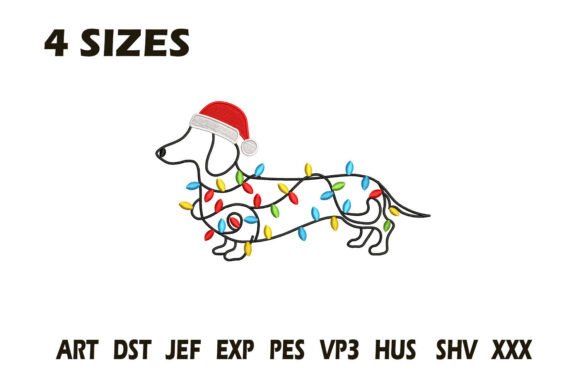
First impression? This isn’t a stiff, over-rendered Santa or a generic reindeer—it’s a dachshund wearing tiny string lights, head tilted, tongue lolling, tail curled like a question mark. There’s warmth in the pose, playfulness in the proportions, and just enough detail to read clearly at 3–4 inches wide without becoming fussy. As a designer who’s stitched hundreds of holiday motifs, I immediately recognized what makes Christmas Dachshund Lights Embroidery different: it balances charm with clarity. It doesn’t try to be everything—it’s not a full scene, not a complex applique design, not a layered monogram. It’s a focused, joyful character that lands instantly.
Where It Shines (and Where It Needs Care)
I tested Christmas Dachshund Lights Embroidery on a natural linen tea towel, a midweight cotton sweatshirt, and a lightweight baby onesie—three very different real-world scenarios for craft businesses and Etsy sellers. On the towel, it stitched cleanly with light tear-away stabilizer; the satin stitch around the dachshund’s outline held crisp definition, and the tiny lights (rendered in short running stitches) read as twinkles—not blobs. On the sweatshirt, I used cutaway + topping, and the fill stitch in the body stayed smooth without puckering. But on the onesie? That’s where attention mattered: the fine details—especially the eyes and light strands—needed tighter tension and a finer needle (75/11). Without that, a few stray stitches softened the expression.
This design thrives on structured, stable surfaces: tote bag designs, pillow covers, aprons, and embroidered patches. It reads well on curved seams (like cap fronts) when hooped carefully and stabilized properly—but avoid placing it directly over thick seams or ribbed cuffs unless you’re willing to re-hoop mid-stitch. It also works beautifully as a standalone motif on holiday gift tags, kitchen towels, or nursery decor—where its personality adds handmade warmth without overwhelming the item.
Fabric & Function: What You’ll Want to Watch
- Thin or stretchy fabric? Use lightweight cutaway stabilizer and consider a temporary topping (like water-soluble film) to prevent thread sinking—especially in the dachshund’s narrow snout and light strings.
- Dark fabric? Test your thread colors first. The design relies on contrast—the lights need brightness to pop. A warm cream or pale gold thread works better than stark white on navy or charcoal.
- Textured fabric (terry cloth, bouclé, fleece)? Increase stabilizer weight and reduce stitch density if possible—or accept that some light detail may soften. It still reads as “dachshund with lights,” but won’t be pixel-perfect.
- Small hoop sizes? Check the file’s smallest recommended dimension before committing. If your hoop is under 4”, consider simplifying or skipping the smallest light strands—they’re charming, but not essential to the design’s identity.
Why It Builds Trust—Especially for Small Shops
Customers don’t buy embroidery files—they buy outcomes. And Christmas Dachshund Lights Embroidery delivers a recognizable, emotionally resonant outcome: delight. I used it on a limited-run batch of organic-cotton tote bags for a local boutique. Buyers didn’t just comment on the stitching—they smiled, snapped photos, and asked, “Is there a matching mug?” That kind of engagement signals strong visual storytelling. For Etsy sellers and handmade shops, that matters more than technical perfection. It feels personal, not mass-produced. It fits seamlessly into branding that values warmth over polish—think small-batch bakeries, indie pet brands, or cozy home goods lines.
That said, it doesn’t suit every brand. If your aesthetic leans minimalist, ultra-modern, or highly graphic, this design might feel too narrative. Likewise, it’s not ideal for corporate gifting or formal holiday mailers—it’s inherently friendly, slightly silly, and proudly handmade in spirit.
Designer Notes You’ll Actually Use
- Always stitch a test on scrap fabric—same type, same stabilizer, same thread. That tiny loop of light behind the ear? It can vanish on low-density fill if tension’s off.
- Review stitch density before scaling. Enlarging beyond 120% may push fill areas too far apart; shrinking below 80% risks losing legibility in the eyes and lights.
- Check licensing before selling finished products. As a commercial embroidery user, confirm whether the digital embroidery file permits resale of physical items—and whether attribution is required.
- Use black-and-white mockups to assess contrast and silhouette. Does the dachshund still read clearly without color cues? (It does—good sign.)
- Compare thread colors across light and dark backgrounds. A single thread palette rarely works equally well on both—plan for two versions if offering custom apparel.
- For baby embroidery or personalized gifts, double-check that all stitch types are safe for sensitive skin—no dense satin borders directly against necklines or wrists.
Final Thought: A Design That Sells Itself
I’ve reviewed dozens of Christmas embroidery files this season—some technically flawless but forgettable, others bursting with detail but impractical for real stitching. Christmas Dachshund Lights Embroidery sits in that rare middle ground: expressive enough to stand out, restrained enough to stitch reliably, and warm enough to make people pause and smile. It’s not background decoration—it’s a conversation starter on a sweatshirt, a signature touch on a holiday apron, a reason someone chooses your Etsy shop over another’s. For craft business owners and designers building a catalog of meaningful, market-ready embroidery project assets, this isn’t just another holiday file. It’s a quietly confident, commercially smart, genuinely cheerful addition to your design assets.