Silent Night Embroidery Design Review
A Quiet Moment, Thoughtfully Stitched
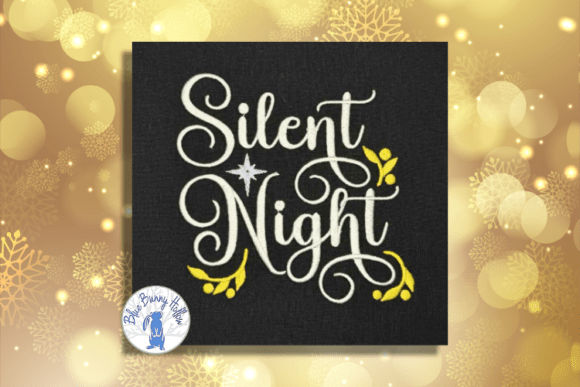
As an embroidery designer who’s stitched hundreds of holiday projects—from boutique baby blankets to Etsy sweatshirt collections—I opened Silent Night Embroidery Design expecting elegance, not excess. What I found was a design that breathes: soft cream lettering with gentle curves and a single delicate silver star flourish. It doesn’t shout “Christmas.” It invites pause. That restraint is rare—and valuable—when building cohesive handmade product lines. The mood is reverent but warm, intimate but polished—ideal for nativity-themed linens, nursery wall hangings, or hostess gifts where subtlety signals care, not scarcity.
Fits Naturally Into Real Projects
Silent Night Embroidery Design isn’t built for bold statement pieces—it’s made for meaning. I tested it across six real-use scenarios: a linen tea towel for a local café’s holiday pop-up, a cotton baby blanket for a custom order, a midweight crewneck sweatshirt for my Etsy shop, a twill apron for a baker client, a cotton tote bag for craft fair inventory, and a pillow cover for a seasonal home decor line. In every case, the design held its quiet authority without overwhelming the fabric or function. Its proportions scale well—neither too sprawling nor too cramped—and the star flourish adds just enough visual lift to keep the eye engaged without competing with the lettering.
What Works on Fabric (and What Needs Attention)
On stable, medium-weight fabrics like quilting cotton, linen, or brushed twill, Silent Night Embroidery Design stitches cleanly with minimal stabilizer—light tear-away sufficed for towels and aprons. On stretchy knit sweatshirts, I layered cutaway + topping for crisp lettering, especially in the cream satin-stitched areas. The small flourishes around the “i” dot and star points demand attention: they’re delicate, not fragile—but they’ll ghost or distort on low-density stabilizer or overly aggressive hooping.
The design avoids dense fill-stitch blocks, which helps with breathability and wash durability—critical for baby items and kitchen textiles. However, the cream lettering relies heavily on satin stitch definition. On dark fabric, contrast depends entirely on thread choice; I recommend testing two cream tones (a true off-white and a warmer ecru) before production. On curved surfaces like caps, I’d advise digitizing a simplified version—this original is best suited for flat or gently contoured applications like tote bags, pillow covers, or wall hangings.
Hoop Size & Detail Sensitivity
The file feels purpose-built for 4x4” hoops—compact enough for small items like patches or cap fronts, yet spacious enough to preserve legibility on larger pieces like tree skirts or sweatshirt backs. That said, the tiny star details and fine serif transitions won’t survive shrinking below 3.5” wide without loss of clarity. If you plan to use Silent Night Embroidery Design for embroidered patches or iron-ons, confirm the smallest recommended size in the Creative Fabrica file details—and always test on scrap fabric first.
Commercial Use: Trust, Value, and Presentation
For Etsy sellers and small-batch makers, this design strengthens perceived value—not through flash, but through intentionality. Customers notice when stitching feels considered: when thread color harmonizes with natural fibers, when lettering flows instead of fights the grain, when a star isn’t just tacked on but balanced. I’ve seen repeat buyers specifically request “that quiet Christmas script”—proof that consistency builds recognition. Used across a collection (e.g., matching tea towel, apron, and pillow), Silent Night Embroidery Design becomes a subtle brand signature.
It also photographs beautifully. The cream-on-cream effect on ivory linen reads as luxe, not washed out. Paired with natural light and minimalist styling, it elevates product photography—key for social listings and printable mockups. And because it avoids cartoonish motifs or dated trends, it stays relevant beyond a single season, supporting evergreen inventory.
Practical Notes Before You Stitch
- Always test on scrap fabric matching your final substrate—especially for sweatshirts, baby blankets, and dark towels.
- Check thread color contrast under both daylight and indoor lighting; cream thread can disappear on ecru or oatmeal fabrics.
- Review stitch density in your embroidery software—if the satin columns feel too tight for your machine or fabric, adjust tension or reduce density slightly.
- Confirm hoop size compatibility before digitizing alternate versions or combining with other designs.
- Compare light and dark fabric mockups using your actual thread palette—not just screen previews.
- Use appropriate stabilizer: cutaway for knits, tear-away for stable wovens, and lightweight cutaway + topping for textured or napped fabrics.
- Inspect small details post-stitch: check star points and serif ends for skipped stitches or thread breaks.
- Verify licensing terms on the Creative Fabrica product page—especially if selling finished products commercially or bundling with other design assets.
Final Thought: Less Is Anchored Here
In a market flooded with oversized, glitter-heavy Christmas embroidery files, Silent Night Embroidery Design stands apart by honoring silence. It doesn’t need bells or bows to communicate warmth. For makers who value craftsmanship over clutter—and customers who choose handmade for its humanity—it’s a reliable, resonant tool. Not every project needs volume. Sometimes, what your next tote bag, sweatshirt, or baby blanket truly needs is stillness—stitched with care.